VOL. 01 · NO. 01 · JUNE 2026 · FORT WORTH, TEXAS
BY INTRODUCTION ONLY
THE
FORT PATTERN
Fort Worth · Texas · Est. 1866
THE COWTOWN
RECTANGLE
One saloon. One block. The story nobody told.
Larry Don Canady
Tim Love
Cody Jinks
Taylor Sheridan
FORT PATTERN
A Note on Why This Exists
Fort Worth just crossed one million residents. The Stockyards ranks 5th nationally among 1,187 leisure landmarks. Taylor Sheridan — a Fort Worth native — is buying buildings on Exchange Avenue and filling the world’s television screens with the imagery of this exact place. The city is in a golden age. And nobody is writing the real story.
Not the tourism story. Not the real estate story. The human story — deeply reported, people-first, verified through real relationships, grounded in the history that most residents don’t fully know, and aimed at the person who is either already here or about to move, invest, or build something.
Fort Pattern is that publication. Issue One is built around a single photograph: a roughstock cowboy named Larry Don Canady riding a bull in a Panhandle arena sometime in the late 1980s. From that photograph, the full Cowtown Rectangle emerges — Tim Love, Cody Jinks, Taylor Sheridan, the White Elephant, Hell’s Half Acre, the Chisholm Trail — all of it connected through one block on Exchange Avenue, all of it verified, none of it previously assembled in one place.
Every issue of Fort Pattern will make someone’s world bigger. That is the only editorial standard that matters.
Contents — Issue 01
Larry Don Canady — The Cowboy
Fort Worth Stockyards, White Elephant, the real West
04
Eight Seconds of Glory — The Arena
Texas Panhandle circuit, roughstock career, timeline
05
What the Photograph Tells You
Primary source analysis, Lane Frost context, the fork
06
The Cowtown Rectangle
Tim Love, Cody Jinks, Taylor Sheridan
07
The Chisholm Trail: 4 Million Cattle
Fort Worth as the last civilized outpost before Kansas
06
Tim Love: 14 Restaurants, Zero Investors
The most underappreciated entrepreneurial run in Texas hospitality
08
Cody Jinks: From the Bar Rail to Billy Bob’s
The bartender who went platinum without Nashville
10
Taylor Sheridan’s Fort Worth
The homecoming that’s changing a city
12
The Most Valuable Block in America
Exchange Avenue, the full map
14
Reader Spotlight
Larry Don Canady — Eight Seconds of Glory
The full story of the Panhandle bull rider who became the connective thread of this issue. Extended portrait, arena career, and the original photograph.
Read Spotlight →
THE FORT PATTERN · ISSUE 01 · JUNE 2026
Larry Don Canady
THE MAN
AT THE END
OF THE RAIL
Every great bar has one. The person whose presence makes the place real. At the White Elephant Saloon — established 1884 in Hell’s Half Acre, Fort Worth, Texas — that person has been Larry Don Canady.
Before the White Elephant, there was the arena. Larry Don Canady competed on the Texas Panhandle roughstock circuit in the late 1980s and early 1990s — bull riding and saddle bronc, both events, which puts him in a rare category. Most riders specialize in one. He had the instinct for the bull and the rhythmic timing that saddle bronc demands.
He rode in Spearman, Texas and the surrounding Hansford County circuit. The banners in the background of the photograph — “Spearman — they’re on dough!” — place the era and the geography exactly. This was the same Panhandle tradition that produced Lane Frost, Tuff Hedeman, and Don Gay. Larry Don rode in that same dirt.
The Beer-Only Settlement
The whiskey version of Larry Don Canady was a force of nature. The solution, negotiated over time with the White Elephant, was elegant: a beer-only menu. Whiskey off the table. Beer fine. Larry Don considered it reasonable. The White Elephant considered it a public service. One of the great negotiated settlements in Stockyards history.
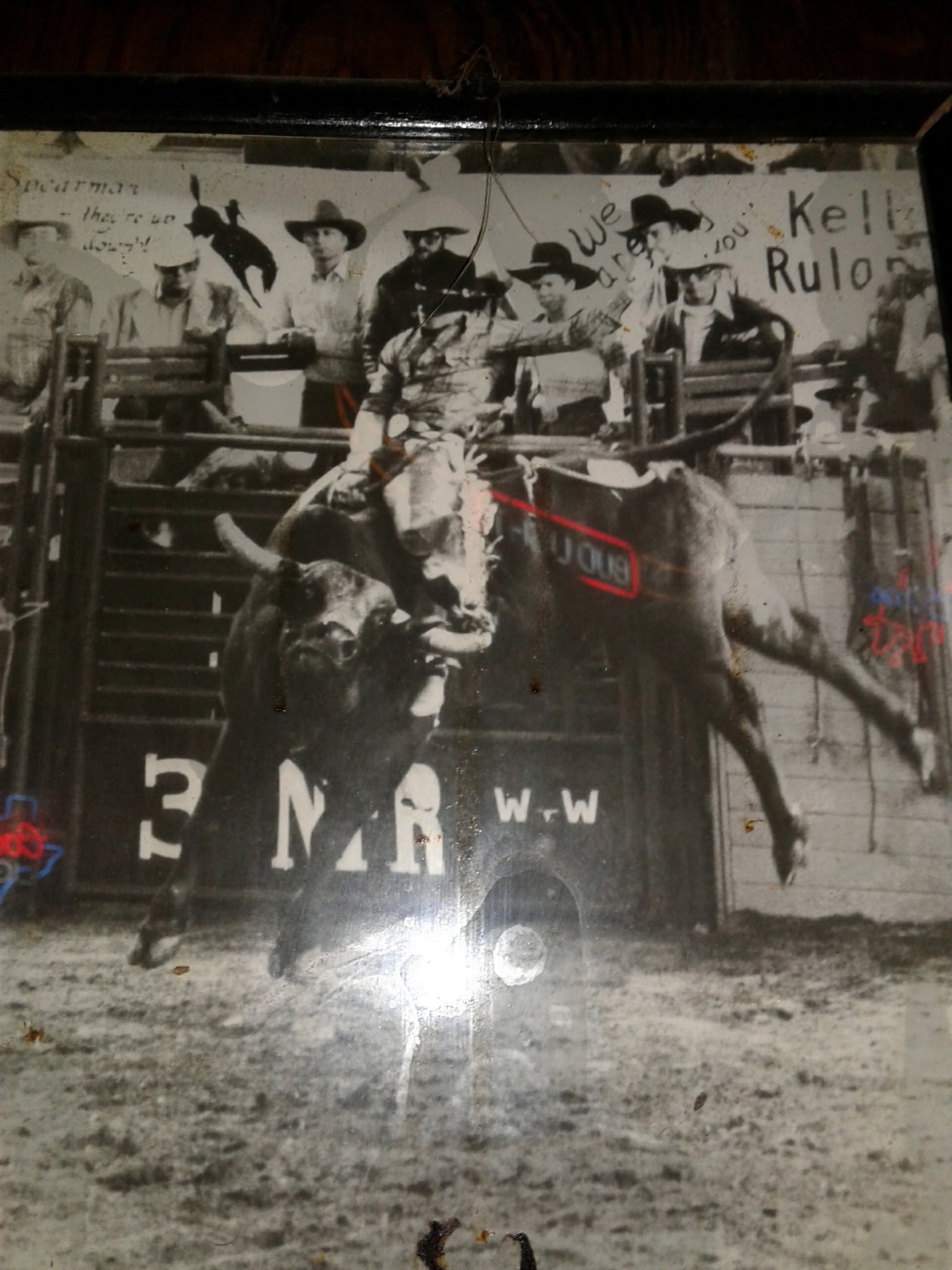
Original photograph, Spearman TX, late 1980s. Bull riding. The real thing.
“When international visitors came looking for the real West, they sat down next to Larry Don. The search was over.”
After the arenas, he became the soul of the White Elephant — the proof that Tim Love’s renovation had not changed what the bar truly was. He taught people how to order the Dirty Love Burger next door. He two-stepped on the old hardwood. He watched Cody Jinks go from bartender to arena headliner without once being surprised that it happened.
Roughstock Circuit — The Facts
Bull riding: 8 seconds to qualify. 100-point scale. The bull accounts for 50% of the score. Saddle bronc: the most technically demanding event in rodeo. Larry Don competed in both. He took the bruises and moved on without making noise about it.
FORT PATTERN · THE COWBOY
Texas Panhandle Roughstock Circuit
EIGHT SECONDS
OF GLORY
Bull riding is the only sport in the world where the scoring clock runs backwards. You don’t win by going fast. You win by surviving. Eight seconds. That’s the whole game.
The Texas Panhandle regional circuit in the late 1980s was not the PBR. There were no TV cameras, no stadium lights, no sponsor banners from energy drink companies. There was dust, a dirt floor, a hand-painted banner from the hometown crowd, and a bull that had been waiting three weeks to throw somebody. Larry Don Canady nodded his head for the gate anyway.
He competed in Spearman, Texas — the heart of Hansford County — and across the surrounding Panhandle circuit. This was the same tradition, the same red dirt, the same family of cowboys that produced Lane Frost, Tuff Hedeman, and Don Gay. Larry Don rode in that lineage, without any of the fame, and without needing it.
What separated him from the weekend warriors was the double discipline. He rode bulls. He also rode saddle bronc — the most technically demanding event in rodeo, the one that requires rhythm and timing rather than just grip and guts. To compete in both is to be a complete roughstock cowboy. That is a rarer classification than most people know.
Career Timeline
LATE 1980s
Enters the Circuit
Begins competing on the Texas Panhandle regional roughstock circuit — bull riding and saddle bronc across Hansford County and surrounding arenas.
1988–90
Peak Competing Years
The era captured in the photograph. Riding rank Panhandle bulls in front of hometown crowds. Bumps, bruises, and buckoffs — the full education.
EARLY 1990s
Still in the Dirt
While the PBR was being founded in 1992 and bull riding went national, Larry Don was still grinding the regional circuit — the real backbone of American rodeo.
LEGACY
Solid as West Texas Limestone
What people remember isn’t the points or the buckles. It’s that he showed up, nodded his head, and hung on — with the quiet integrity of a true Texas cowboy.
Spearman, TX — late 1980s. Crowd banner: “Spearman — they’re on dough!”
The Events
BULL RIDING
8 seconds. 100-pt scale. Bull scores 50%. Confirmed — photo proof.
SADDLE BRONC
Rodeo’s classic event. Rhythm and finesse. Confirmed by those who knew him.
“He didn’t need the national belt to earn respect. The Panhandle already knew what it had.”
The Scoring Rule
A bull rider is disqualified if they touch the bull, the rope, or themselves with their free hand. They must also mark out — spurs above the break of the shoulders on the first jump. Eight seconds feels like eight minutes when the animal weighs 1,800 pounds and has no agenda except ending the ride.
FORT PATTERN · LARRY DON CANADY
The Original Document
WHAT THE
PHOTO TELLS
YOU
Every real story starts with a primary source. For Larry Don Canady, that source is a single black-and-white photograph taken at a Spearman, Texas area rodeo in the late 1980s. It’s the kind of image that can’t be staged.
There are four things visible in the photograph that confirm the story without any words needed. First: the crowd behind him. These are not spectators at a modern PBR event. They are weathered Panhandle cowboys in wide-brim hats, leaning on the fence rail as men do when they know exactly what they’re watching. Nobody there is looking at their phone.
Second: the bull’s position. Hindquarters kicked high, body twisted mid-air — this is a rank bull giving everything it has. A rank bull in Panhandle language means an animal that has earned a reputation. It doesn’t get easier. It gets harder every time out.
Third: the banner in the background. “Spearman — they’re on dough!” This is not a professional production. This is a community coming out to cheer for its own. That crowd has names for every person in that arena.
Fourth: Larry Don’s form. One hand on the rope. Body aligned over the bull’s back. Free arm reaching for counterbalance. This is not a man getting thrown — this is a man mid-ride, working it out in real time. That’s the difference between a rider and a tourist.
What the Photograph Confirms
LOCATION
Spearman, Texas area — Hansford County. Banner in background is explicit confirmation.
ERA
Late 1980s. Crowd clothing, film grain, arena structure, and signage all confirm pre-1992.
DISCIPLINE
Bull riding. Flat braided rope visible. Bull’s hindquarters above shoulder height. Legitimate roughstock.
CROWD
Cowboys. Not tourists. The secondary banner reads “We are for you, Kell Rulon” — another rider in the same event.
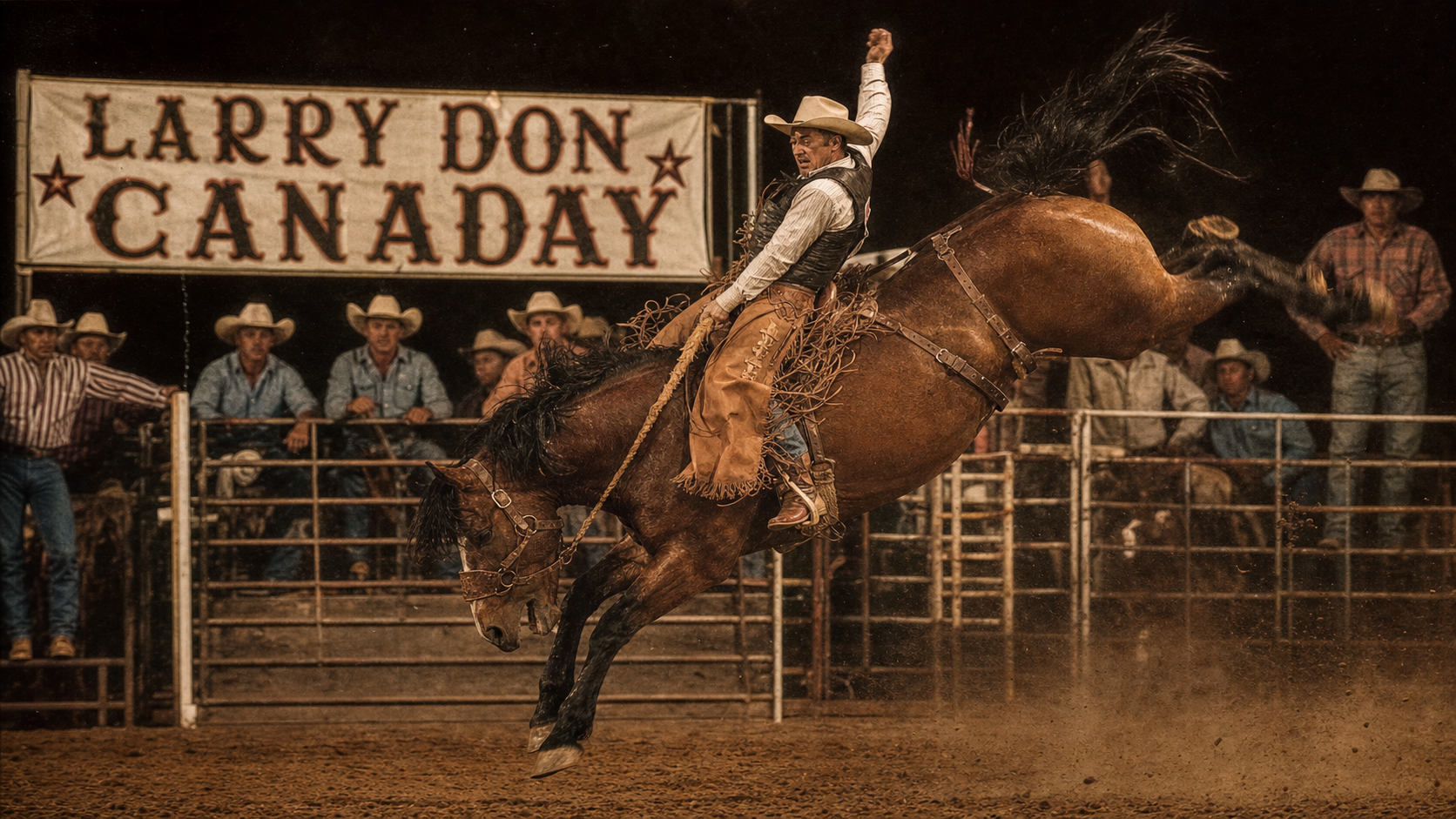
AI tribute image. The spirit of the original — Fort Pattern Issue 01, 2026.
“He didn’t come from behind the rope. He came from the same dirt the cattle drive was built on.”
The Fork in the Road
The arena years end. The White Elephant years begin. From Spearman to Exchange Avenue — from the Panhandle circuit to Fort Worth’s oldest honky-tonk. Larry Don Canady didn’t leave the cowboy life behind. He just found a different kind of arena. That transition is where the Cowtown Rectangle begins.
Lane Frost Context
Lane Frost — 1987 World Champion Bull Rider — was killed by a bull at Cheyenne Frontier Days in 1989. He was 25. He came from the same Panhandle-adjacent tradition as Larry Don. They were contemporaries. That’s the weight of the era Larry Don was riding in.
FORT PATTERN · LARRY DON CANADY
The Chisholm Trail
FOUR MILLION
CATTLE
Between 1866 and 1890, drovers trailed more than 4 million head of cattle through Fort Worth on the Chisholm Trail. The city was not just a stop. It was the last civilized outpost before the open range — where cowboys restocked, spent money, made decisions, and often made trouble.
THE TRAIL — NORTH TO KANSAS
San Antonio, TX
Southern origin. The herds assembled here.
Waco, TX
The Brazos River crossing. Major rest stop.
FORT WORTH, TX
The last civilized outpost. Cowboys spent everything here.
Red River Station, TX
The crossing into Indian Territory.
Abilene, KS
The railhead. End of the drive. Payday.
4M+
Cattle through Fort Worth 1866–1890
1876
Texas & Pacific Railway arrives
1884
White Elephant founded — same year
Hell’s Half Acre
WHERE THE
COWBOYS
ACTUALLY WENT
The cattle bedded down north of downtown. The cowboys did not. They headed south to a district the newspapers called Hell’s Half Acre: saloons, dance halls, gambling parlors, and bordellos running from Seventh Street to Fifteenth Street along the main north-south corridors of Fort Worth.
By 1881, local papers were complaining it covered 2.5 acres. Wyatt Earp passed through. Doc Holliday allegedly visited. The money from every cattle drive evaporated here in a single night, and the cycle began again come spring.
The White Elephant — Born 1884
The White Elephant Saloon was established in 1884 in Hell’s Half Acre. It survived the cleanup of the district, relocated to the Stockyards in the 1970s, and has been on Exchange Avenue ever since. The bar Larry Don Canady calls home is 140 years old. Most of the people who drink there don’t know that.
1976: National Historic District
The Fort Worth Stockyards was designated a National Historic District in 1976 — 100 years after the railroad arrived. The designation preserved the architecture. Today it hosts the world’s only twice-daily cattle drive: 11:30 AM and 4:00 PM, every day, real cowboys, real longhorns, same bricks.
“Every day at 11:30 AM and 4 PM, the Fort Worth Herd saunters through the Stockyards — a living tribute to Texas’ rich cattle-driving history.”
The Stockyards now ranks 5th nationally among 1,187 leisure landmarks. The place where Larry Don Canady holds his beer is one of the most visited heritage destinations in the United States.
THE FORT PATTERN · ISSUE 01 · JUNE 2026
Cody Jinks
BARTENDER
TO BILLBOARD
Born Haltom City. Former thrash-metal frontman. Got a job at the White Elephant in his early twenties. Poured drinks on the same rail where Larry Don sat every night. Played Wednesday sets upstairs while the bar closed below him. Never signed a major label. Went platinum anyway.
In His Own Words — Verified
“At 23, I got my old job back, I bartended a few more years until 2007 when I started playing music full time.” — codyjinks.com. Multiple Fort Worth sources confirm the White Elephant. April 2008: he opened a Clubhouse Concerts show upstairs at the same building where he was still transitioning out of bartending. Larry Don was a regular on both sides of that bar.
Early 2000s
Bartending + Wednesday nights upstairs
Larry Don at the end of the rail. Building slowly. No deal.
2007
Goes full-time as a musician
Fifteen years of grassroots touring. Vans. $500 shows. Owned 100% of everything.
2015–16
“Loud and Heavy” platinum — I’m Not the Devil Billboard Top 5
No Nashville deal. No compromise. All his.
Today
Headlines Billy Bob’s Texas
Two blocks from where he used to pour drinks. Larry Don watched the whole climb.
Taylor Sheridan
THE HOMECOMING
THAT’S CHANGING
A CITY
Fort Worth native. Father was a cardiologist here. Grew up riding. Spent years acting in Hollywood — Sons of Anarchy, Veronica Mars — before Sicario and Hell or High Water announced him as the defining voice of the modern American West. Then he came home.
| Project | Status |
|---|
| Cattlemen’s Steakhouse | Purchased June 2025. Renovated & reopened. |
| Art Gallery | West Exchange Ave. Part of $1B expansion. |
| SGS Studios | Texas’ largest film studio. Alliance Texas. Paramount + Hillwood. |
| Bosque Ranch | 1,000 acres. Weatherford TX. Annual festival. |
| Landman filming | Entire production in Fort Worth. $1B+ film economy. |
The Forbes Set-Jetting Boom
Forbes declared a “set-jetting boom” as Landman fans fly to Fort Worth to walk the filming locations. The world is arriving at exactly the place this story was already happening.
THE REAL FORT WORTH WAS HERE BEFORE THE CAMERAS. IT WILL BE HERE AFTER.
THE FORT PATTERN · ISSUE 01 · JUNE 2026
The Cowtown Rectangle — Verified
ONE STREET. FOUR CORNERS.
THE WORLD IS JUST NOW NOTICING.
| Person | Their Role in the Story | The Key Fact |
|---|
| Larry Don Canady | The authentic Texas cowboy who gave Tim Love’s bar its soul. The man Cody Jinks looked at every shift behind the bar. | Panhandle roughstock circuit. Bull riding & saddle bronc. Beer-only menu. Held court for decades. |
| Tim Love | Built the stage for all of it. No investors. No compromises. Bought the oldest honky-tonk in Texas and kept it real. | 2000: Lonesome Dove. 2004: White Elephant. 2007: Iron Chef win + Love Shack. 2026: 14+ restaurants. Zero outside capital. Always. |
| Cody Jinks | Bartended at the Elephant while Larry Don drank. Played Wednesday nights upstairs. Built a career on his own terms. | Bartended through 2007. Platinum. Billboard Top 5. Now headlines Billy Bob’s two blocks away. |
| Taylor Sheridan | Fort Worth native returning home with the most powerful TV universe in America. The world is now looking at this block. | Cattlemen’s. Art gallery. Texas’ largest studio. $1B+ film economy. Set-jetting boom. |
| Place | Address | Connection |
|---|
| White Elephant | 106 E. Exchange | Est. 1884. Tim Love since 2004. Larry Don’s home bar. Cody Jinks poured drinks here. |
| Love Shack | 110 E. Exchange | Tim Love, 2007. Dirty Love Burger. Larry Don knew how to order it. |
| Lonesome Dove | 2406 N. Main | Tim Love’s flagship since 2000. The anchor of the empire. |
| Cattlemen’s Steakhouse | 2458 N. Main | 78 years old. Taylor Sheridan bought it June 2025. |
| Billy Bob’s Texas | 2520 Rodeo Plaza | World’s largest honky-tonk. Cody Jinks headlines here — two blocks from the Elephant. |
| Cowtown Coliseum | 121 E. Exchange | Year-round rodeo. Larry Don knew this stage from the chute side. |
FORT WORTH — THE NUMBERS RIGHT NOW
1M+
Residents — crossed 2025
#1
Real Estate Market — 2025 & 2026
$1B+
Sheridan Film Economy
5th
National leisure landmark among 1,187
FORT PATTERN · EXCHANGE AVENUE
THE DYNASTY PUBLICATIONS STACK — VOL. 01 · NO. 01 · JUNE 2026
NO. 01
THE FRISCO PRESTIGE
Lane One · Frisco / Collin County
NO. 02
THE CORRIDOR THESIS
Lane Two · Economic Intelligence
NO. 03
THE DYNASTY CAMPUS
Lane Three · Flagship Infrastructure
NO. 04
THE CORRIDOR VOICE
Lane Four · Fort Worth Edition
NO. 05
THE FORT PATTERN
Lane Five · Fort Worth Heritage & Culture
DYNASTY
Where the Corridor Builds. Where the Pattern Holds.
VOL. 01 · NO. 01 · JUNE 2026 · FORT WORTH, TEXAS
BY INTRODUCTION ONLY
ONE STREET.
FOUR LEGENDS.
THE WORLD IS
JUST NOW NOTICING.
Dynasty Publications · Fort Worth, Texas · I-35 · I-20 · The Texas Corridor · DFW Metro
The Fort Pattern · Issue 01 · Volume 01 · June 2026 · All content original and verified · Public domain editorial · No reproduction without attribution
© 2026 Dynasty Publications · Fort Worth TX · By Introduction Only · fortpattern.com